
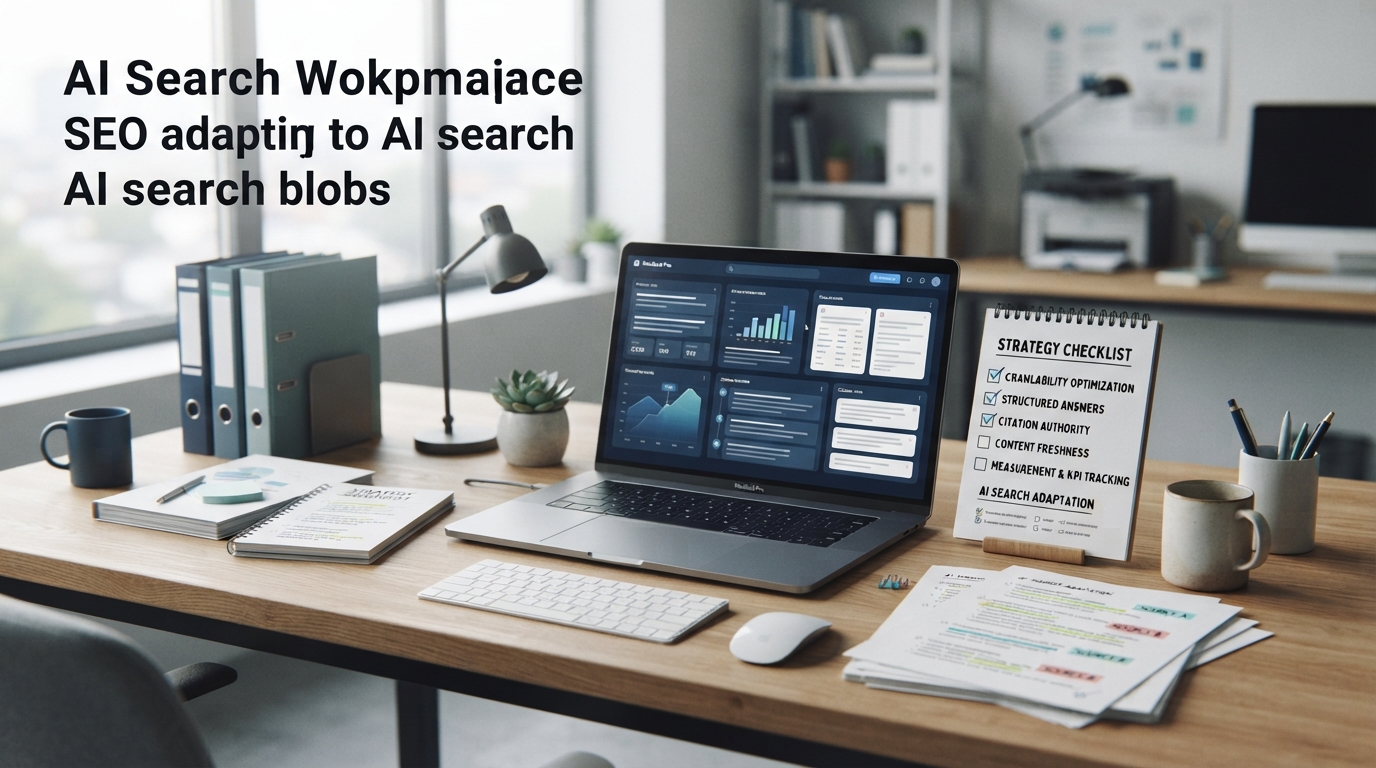
The weakest argument in search right now is also the loudest one: SEO is dead because people are using AI tools. That framing is too simple. Search is not disappearing. It is fragmenting across classic Google results, AI Overviews, AI Mode, ChatGPT, Perplexity, YouTube, TikTok, Reddit, and industry-specific communities.
The practical question for 2026 is not whether SEO survives. It is whether your SEO operating model can handle a discovery journey where users ask longer questions, AI systems summarize multiple sources, and visibility may show up as a cited source rather than a blue-link ranking.
This batch of LinkedIn saved items points to a useful answer: modern SEO teams need stronger fundamentals, better AI-assisted workflows, and measurable AI visibility. The work is less about defending old SEO and more about upgrading how SEO decisions are made.
The shared pattern: SEO needs an operating model for AI search
The three practitioners in this batch are not making the same point, but their ideas connect clearly.
- Aleyda Solís argues that AI search is expanding and evolving search rather than killing it.
- Adrian Turcsan argues that AI-assisted SEO fails when teams ask for generic insights instead of using structured workflows.
- Abhinav Matura points to AI Overview tracking as a sign that AI search visibility is becoming measurable.
Together, they suggest a more useful model: SEO teams should treat AI search as a new visibility layer on top of existing search fundamentals. The foundations still matter, but the workflow needs to change.
Aleyda Solís: SEO is not dead, but discovery is spreading
Aleyda Solís challenged the claim that SEO is dead because users now search through LLMs. Her post cites Similarweb figures showing Google still far ahead of ChatGPT in visits, while also noting that many users overlap across both platforms.
The stronger point is not just the traffic comparison. It is that search behavior has always changed. SEO used to mean optimizing for web pages in Google. Today it can include Google, AI Overviews, AI Mode, ChatGPT, Perplexity, YouTube, TikTok, app stores, and other search-like surfaces.
Google’s own documentation reinforces this direction. Its explanation of AI Overviews says the feature is built alongside existing Search systems, ranking systems, and the Knowledge Graph, with links to supporting web content. In other words, AI search does not remove the need for crawlable, relevant, trustworthy content. It changes how that content may be surfaced.
2026 relevance verdict: current. The “SEO is dead” claim is still a weak diagnosis. The better diagnosis is that SEO is no longer only a ranking discipline. It is becoming a visibility and retrieval discipline across search, answer, and recommendation surfaces.
Practical takeaway: keep the fundamentals: crawlability, indexability, relevance, internal linking, entity clarity, expertise signals, and user satisfaction. Then add AI-search monitoring and answer-ready content structure on top.
Adrian Turcsan: generic AI prompts are not an SEO workflow
Adrian Turcsan argued that many SEOs use AI incorrectly. They paste data into a chat window, ask for “insights,” and get generic output. His solution is to encode specialist SEO frameworks, scoring criteria, and workflows into reusable AI skills.
This is an important operational point. AI does not automatically make SEO work better. It can make bad processes faster. If the input is unclear, the methodology is missing, and there is no route from diagnosis to action, the output will feel plausible but remain hard to trust.
The useful idea here is workflow routing. A content gap should feed a content brief. A technical audit should route schema issues to a schema workflow. A Search Console anomaly should route into traffic-drop diagnosis before anyone rewrites the page. That is how AI becomes an SEO operating layer instead of a generic assistant.
2026 relevance verdict: current. As SEO expands into AEO and GEO, teams need more structure, not less. AI-assisted SEO should make expert methods repeatable. It should not flatten expert judgment into generic recommendations.
Practical takeaway: turn repeated SEO work into named workflows. Examples include crawlability audit, indexation diagnosis, content gap analysis, search intent mapping, title and meta optimization, internal linking, AI search optimization, and Search Console analysis.
Abhinav Matura: AI Overviews become real when they become measurable
Abhinav Matura highlighted Semrush adding AI Overview tracking inside Organic Research. The post itself is short, but the implication is useful: AI search is moving from speculation into measurement.
Semrush’s documentation says AI Overview data can be reviewed in tools such as Position Tracking, Organic Research, Domain Overview, Keyword Overview, Keyword Magic Tool, and Sensor. In Organic Research, marketers can see keywords where a domain is cited as a source in AI Overviews. In Position Tracking, teams can monitor whether target keywords trigger AI Overviews and whether the domain appears as a source.
This changes the SEO conversation. Instead of asking whether AI search matters in general, teams can ask more practical questions: which queries trigger AI Overviews, which competitors are cited, which pages are cited, and where the brand is absent despite ranking organically.
2026 relevance verdict: current. AI search visibility is still messy, but it is increasingly measurable. Google Search Console does not cleanly separate AI Overview impressions in the way many SEOs want, so third-party tools and manual audits remain useful for directional analysis.
Practical takeaway: add an AI Overview visibility check to content refresh and competitor analysis workflows. Do not treat it as a replacement for classic SEO reporting. Treat it as another visibility layer.
What still applies in 2026
1. Indexability still comes first
Google’s Page Indexing report documentation is clear: pages may be missing because of robots.txt rules, noindex tags, duplicate handling, canonicalization, redirects, login requirements, or normal crawl/index delays. AI-search optimization cannot rescue a page that search systems cannot crawl, index, understand, or trust.
2. Answer structure matters more than before
AI Overviews and answer engines reward content that can be extracted, summarized, and supported by sources. That does not mean every page should become a FAQ dump. It means pages need clear headings, direct answers where useful, evidence, entity clarity, and sections that still make sense when quoted out of context.
3. Measurement needs multiple layers
A modern SEO report should not stop at rankings. It should include classic organic clicks and impressions, indexing health, content-change history, AI Overview triggers, citation presence, competitor citations, and conversion quality. No single metric explains the whole search journey anymore.
What needs updating
The industry should stop treating SEO, AEO, GEO, AIO, and SXO as competing labels. These terms are useful only when they clarify the work.
- SEO protects discoverability across search systems.
- AEO makes answers easier to extract.
- GEO improves citation and mention potential in generative responses.
- SXO connects visibility with user satisfaction and conversion.
The labels matter less than the operating loop: diagnose, prioritize, improve, measure, and learn.
A practical SEO operating loop for AI search
- Start with crawl and index health. Check whether important pages are indexed, canonicalized correctly, and available without blockers.
- Map the question set. Identify the questions, comparisons, and follow-up prompts your audience uses when researching the topic.
- Audit current visibility. Check rankings, AI Overview triggers, cited sources, competitor mentions, and missing pages.
- Improve answer clarity. Add direct answers, better headings, evidence, examples, source support, and concise summaries where useful.
- Route findings into workflows. Technical issues go to technical SEO. Content gaps go to briefs. Weak snippets go to title and meta work. AI citation gaps go to entity and answer-structure improvements.
- Review before scaling. Use AI to accelerate analysis and drafting, but keep expert review on strategy, claims, and prioritization.
Where this fits GrAIvity’s view
GrAIvity’s position is not that AI replaces growth strategy. It is that growth, AI, and creativity need to work together. AI search is a good example. Growth defines what visibility should achieve. AI helps process more signals and create better workflows. Creativity keeps the content worth choosing, citing, and remembering.
For UAOS, the same idea applies to learning systems. A useful system does not only generate answers. It understands context, retrieves the right material, adapts to feedback, and guides the next action. Modern SEO needs that same operating discipline.
Related reading: measuring the AI search journey, and SEO workflows before agents.
Frequently asked questions about SEO and AI search
Is SEO dead because of AI search?
No. SEO is not dead because of AI search. Search behavior is changing, but AI Overviews and AI Mode still rely on web content, ranking systems, and supporting links. The work is shifting from classic ranking alone toward visibility across search, answer, and citation surfaces.
What is the difference between SEO, AEO, and GEO?
SEO improves discoverability in search systems. AEO makes content easier for answer engines to extract and present directly. GEO focuses on being cited, mentioned, or trusted inside generative AI responses. In practice, they overlap. Strong pages usually need all three: crawlable foundations, clear answers, and credible entity signals.
How should teams track AI Overview visibility?
Teams can track AI Overview visibility by checking which target queries trigger AI Overviews, whether their domain is cited, which competitor pages are cited, and how this changes over time. Tools such as Semrush Position Tracking and Organic Research can help, but manual review is still useful for important queries.
Should AI write SEO recommendations?
AI can draft SEO recommendations, but expert review should decide which recommendations matter. The better workflow is to give AI a clear method, data source, scoring criteria, and output format. Without that structure, AI often produces generic advice that sounds useful but does not lead to a prioritized action.
What is the safest first step for AI-assisted SEO?
The safest first step is a read-only diagnostic workflow. Use AI to summarize Search Console data, inspect indexing patterns, cluster query intent, or identify pages that need clearer answers. Keep publishing, redirects, noindex changes, and budget decisions behind human review.
For a practical framework that separates AI citations from broader search visibility, see GrAIvity’s guide to measuring AI citations.
Sources
- Aleyda Solís on LinkedIn
- Adrian Turcsan on LinkedIn
- Abhinav Matura on LinkedIn
- Google: AI Overviews and AI Mode in Search
- Google Search Console Help: Page indexing report
- Semrush: SERP Features, AI Overview
- Semrush: How to Track AI Overviews with Semrush
